

Truck lives are like people’s lives, they go through a variety of uses. When we’re young, we are full of energy, we have robust bodies that require minimal maintenance. As we age, our maintenance increases as measured by the number of doctor’s visits, prescriptions, etc. We are less able to do what we did in our youth. As we get into our more senior days, our daily mileage decreases significantly and our maintenance costs skyrocket.
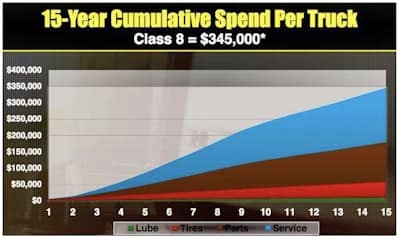
Trucks are like that. One report by CCJ‘s editor Jason Cannon back in 2016 illustrated from McKay & Co. data the way costs for operating trucks increase with time.
 2016 illustration from McKay & Co.
NACFE describes a Class 8 semi-truck as having multiple personalities.
NACFE describes a Class 8 semi-truck as having multiple personalities. The initial buyer for a new OEM truck is often looking at on-highway applications where a lot of miles can be accumulated quickly, and where aerodynamics, low-rolling resistance tires, lightweight materials, etc. have their greatest impact on reducing operating costs. These new trucks also have factory warranties to cover maintenance and repairs. They also likely have less downtime than older trucks.
That new truck buyer probably only holds onto that truck for two, three, four or five years, and then trades it in when buying another new truck. That first period of ownership is based on a lot of economic and policy choices for each fleet, and there may be significant priorities for each fleet owner. Often the years correspond to miles they’ve accumulated.
That first trade-in converts a new truck into a used truck awaiting a second owner. That second owner can have entirely different economics and policies to consider in procuring a truck. Features that mattered to the first buyer may carry no value for the second buyer. That second buyer likely has a different duty cycle planned for the truck. But that second buyer is still very concerned about minimizing operating costs. Older trucks tend to have higher failure rates, more downtime per year based on accumulated mileage. To minimize these increasing costs, the second buyer often changes the duty cycle to one that has fewer miles per year, so instead of long-haul on-highway, it may become regional haul or local haul. That second owner still runs the truck hard, but the application has fewer miles per year, effectively containing maintenance costs.
After several years, the second owner can no longer avoid the increasing costs of operation and trades the truck in, and a third owner will come along and buy it. That third owner similarly is concerned about containing operating costs per mile so puts the truck into an even shorter miles-per-year application like bulk hauling, or hauling gravel, sand, liquids, chemicals, or for dunnage, etc. The truck in the new duty cycle also is run hard but accumulates fewer annual miles.
After these three lives, the truck may get sold again and have a new life literally going to pasture. The fourth owners of many vehicles may use those trucks in agricultural duty cycles where they see intermittent usage based on seasonal demands.
A fifth life might be as a restored antique show truck hauling the occasional load and doing the show truck circuit. Or more likely, the truck is parted out and scrapped, completing its useful life.
Like people, every truck has its own life’s story, a path unique to itself. Some are well taken care of over their lives, while others lead very hard lives with little attention paid to their care.
A consistent formula may be to look at minimizing operating costs over time by reducing vehicle miles traveled. Nearly all truck operating costs are tied in some way to miles/year factors. Metrics like mean-time-to-failure (MTTF) are tied primarily to accumulated mileage. There are others tied to pure age as materials can degrade just from being older.
Truck longevity also varies considerably by region. Average truck life in other countries can be significantly different than those in the U.S. Truck longevity in the Northeastern U.S. may vary dramatically from those in the Southwestern U.S. Trucks in the U.S. and Canadian Rocky Mountain regions may see different lifespans than those in the flat central Plains regions.
When the truck leaves the factory headed to that first owner, it has no idea where its path will take it over its lifetime, who will own it and how it will be used. That first buyer exerts a huge influence on the specifications of the truck that may or may not help it through its many lives. Aerodynamic choices by the first owner may mean little to a third or fourth owner doing short urban bulk hauls or farm runs. Lightweighting spec choices may not be valued if they lead to shorter truck life. Features like spacious luxurious sleepers may not be important to a downstream drayage operator who just needs a vehicle to pull containers.
All these choices by the first buyer face ever-changing downstream market conditions governed largely by basic supply and demand. This is why estimating residual value is less a science than an art with considerable need for luck.
Just as you have gone through multiple stages to get to where you are today, trucks see similar life paths. The challenge for those academics developing lifetime models is that they really don’t control the future and can’t predict well all the variables and choices that will be made about a given truck.
The constant theme for both people and trucks is that maintenance costs increase with age and miles. How we use those years and miles is up to each of us to get the most value.