

This year has been anything but the status quo. The new administration has disrupted everything from energy policy to emissions regulations to incentives to tariffs. While we still have plenty of uncertainty, we are now deep into the summer months, and it is time for companies to start building their 2026 annual operating plans.
One critical step is to refresh your company’s product roadmaps. Given all these changes, you should spend time asking if the current product portfolio will work with the new set of rules. Given the changes that have occurred regarding the Advanced Clean Fleet (ACF) rule, and potential changes that might be made to the Greenhouse Gas Phase 3 (GHG3) and Environmental Protection Agency (EPA) Low NOx rules, there is a shift in the industry from “regulation-driven” to “value-driven.” This was evident at ACT Expo this year where there was a common theme of the need to develop customer-driven solutions.
Companies that revisit their product plans are more likely to come out on top. If they can find solutions that provide value to the customer, while at the same time improving efficiency and reduce emissions, they can differentiate themselves, grow market share, and delight the customers.
What is a product Roadmap?
Product roadmaps communicate on one or a few sheets of paper the different product offerings over time. Some of the best product roadmaps appear so simple to the eye but reflect endless hours, and in some cases, millions of dollars that have been invested to create them. They are the “single source of truth” that the company uses to communicate to customers and suppliers. They also are used internally to align all functions within the company from marketing to engineering to manufacturing. Decisions regarding staffing, capital investments, marketing activities, etc. are based on what is on the roadmap.
Product roadmaps often are viewed as confidential and while shared with customers, a Nondisclosure Agreement (NDA) is often needed. Every company in the industry should have a roadmap. Here are a few examples of what might be on a product roadmap.
OEMs
The vehicle manufacturer will illustrate the major vehicle models by class. They might show the different type of fuel (e.g. diesel, natural gas, electric, hydrogen). They might show whether the vehicle is a line-haul sleeper, regional day cab or vocational truck. Features such as Advanced Driver Assistance Systems, automated manual transmission, or braking systems might also be illustrated.
Tier I suppliers such as manufactures of engines or transmissions
These Tier I suppliers will illustrate their product offerings and will share horsepower, torque, fuel type (e.g. diesel, natural gas, electric, hydrogen.), number of gears, whether the transmission is automated or manual, etc. Given the several decades of emission regulations that our industry has implemented, these roadmaps typically show product changes aligned to emission changes. For example, as we approach the EPA Low NOx Rule, there will be product changes, and the roadmap will likely show these changes taking place in 2027 (or possibly in 2026).
Tier II and electronics
These suppliers also have their own product roadmaps. A company that produces inverters for electric vehicles might illustrate the type of motor driver such as Silicon or Silicon Carbide. Also, they might illustrate the voltage of the inverter (e.g. 400 vs 800 Volts). Other examples in the electronic space would illustrate different types of sensors (pressure, temperature, voltage, etc), actuators, etc.
The Messy Middle is a roadmap
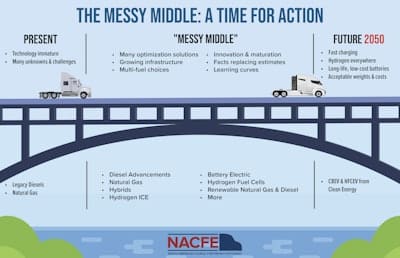
While I don’t think we have ever called it a product roadmap, NACFE’s Messy Middle illustration shown in Figure 1 is somewhat of a roadmap for the industry. Note there is a time horizon of “Present” to “Future 2050,” and the different types of powertrains are listed ranging from legacy diesel to natural gas to hybrids to electric vehicles, etc.
 NACFE
NACFE
Are there other types of roadmaps?
There are other types of roadmaps as well. Two examples are Technology Roadmaps and Service Roadmaps. A company might have a technology roadmap to illustrate different concepts it is considering for products that might be 10 to 15 years out. These roadmaps don’t always translate into products. They typically list several concepts and technologies that are being evaluated. If the concept shows promise, then the technology will show up on a product roadmap in the future. Some concepts are tried and do not work and then just get archived. A Service Roadmap might illustrate concepts like diagnostics, prognostics, virtual tools, etc. that can be used by service technicians.
Guidelines for developing a product roadmap
There are significant changes occurring in the industry. Prior to the administration change, we were being driven a lot by regulation (ACF, GHG3, etc.). While we do not have a clear story as to how all this regulation will change, it certainly feels like the industry is shifting away from regulations to solutions and products which are less about regulation and more about value. A company should always revisit its product roadmaps, but it is more important now than ever. Also, while we are experiencing this shift, products that can provide value as well as reduce emissions will be the real winners.
Below are some ideas to consider as you revisit your product roadmap. Every company in the industry can apply these, whether you work for a major OEM, a Tier I supplier, or you are in the software and electronics industry.
- Revisit your company’s mission and vision: The roadmap is the result of the company’s vision. While these statements are core to the company and should not change often, they are worth revisiting given all the changes that are taking place.
- Start with macro trends, geopolitics, etc.: What has changed over the last several years? Will fleets be mandated to use your products because of emission regulations (e.g. low carbon alternatives)? What happens if GHG3 or the Advanced Clean Truck (ACT) Rule are delayed? Do you still have a product line-up that can succeed in an unregulated or less-regulated environment? What about the emphasis of functional safety, cybersecurity, ADAS?
- Create scenarios: Consider all the macro trends listed above. Create scenarios and ask whether your product line-up meshes with these scenarios.
- Keep your ears to the ground: Establish a process to collect feedback from customers and suppliers. Always talk to your customers and supply base to determine what needs they have. Ask them their opinions on industry trends. Pull these voices into the creation (or modification) of your product roadmap.
- Apply Minimum Viable Product (MVP) or other techniques: MVP is a product development strategy designed to collect feedback on the performance and perception of a product. It promotes the idea of creating prototypes and gathering customer feedback in a timely manner. Rather than investing in multi-million-dollar products and then finding they do not meet the customers’ needs, companies develop concepts and prototypes quickly and collect input as the prototypes are completed.
- Differentiate your product: Successful companies innovate and gain a competitive advantage. Is your product line-up a collection of “me too’s,” or do your products have an advantage in terms of performance, capacity or features? How do your products offer value to your customer and over the competition? Your product line-up needs this, and your roadmap should reflect this.
- Include all voices: All functions — marketing, service, engineering, manufacturing, management, product architecture, product management, etc. — should have a voice in the roadmap. At the end of the day, product management and senior management will make the call, but all internal voices should be heard.
- Go for the win: Change is hard. The business world (and most of us humans) likes certainty and stability. While changes are painful, they can also be viewed as opportunities. The companies that reflect on the changes and adjust their strategies and product roadmaps will come out winners.
- Refresh: Continuously monitor trends, connect with customers, and ask if you have the right strategy and product roadmap. Integrated Business Planning (IBP) forces all functions to review product roadmaps on a 12- to 36-month time horizon. The review occurs monthly and forces a constant review and refresh. Consider adding IBP to your operation.
This has been a very turbulent year with an abundance of changes and challenges. The industry is clearly shifting from where it was just a few years ago. Companies that recognize these changes and revisit their strategies and product roadmaps are likely to come out on top, growing market share, becoming leaner and more efficient, improving customer satisfaction, and succeeding.