
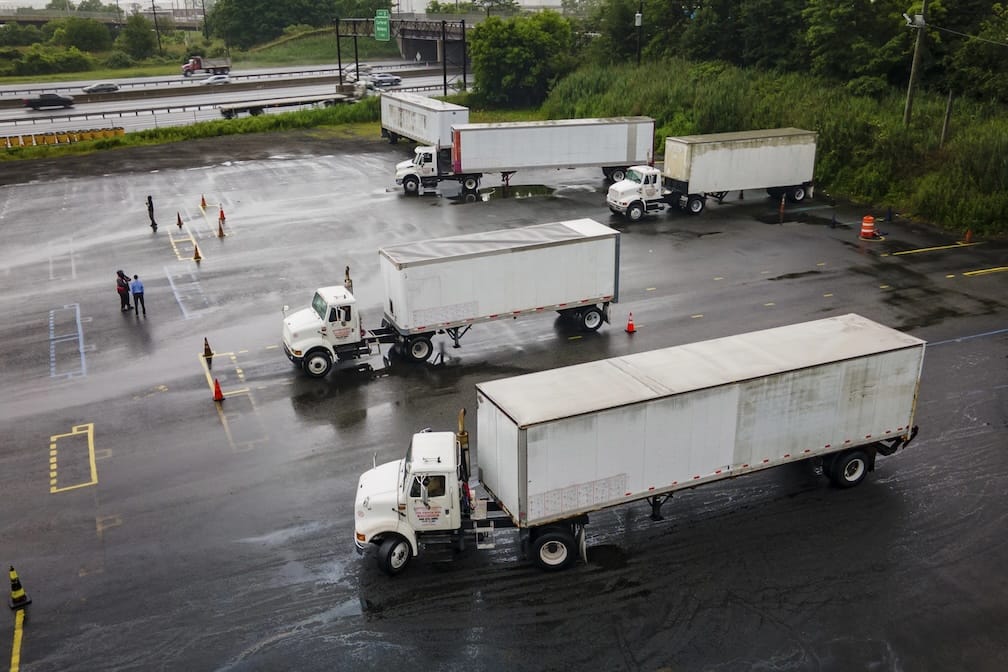

In Linden, New Jersey (AP) — Students at a trucking school are practicing with 18-wheelers, skillfully navigating them through a course marked by traffic cones. Some future drivers inspect the engines of vehicles to conduct safety assessments, explaining their process as they look for any damage or leaks in the steering hoses. Meanwhile, an instructor smoothly alternates between Spanish and English while guiding Manuel Castillo, who speaks Spanish as his first language, on how to evaluate a school bus. A printed script containing English phrases is being utilized for practice regarding what Castillo might communicate during a roadside inspection. The need for truck drivers, both current and aspiring, to improve their English skills has become more pressing following an executive order from President Donald Trump. This order states that truckers lacking proficiency in reading and speaking English would be deemed unqualified for their roles. “A driver who is unable to understand English will not be permitted to operate a commercial vehicle in this country.” “Period,” stated Transportation Secretary Sean Duffy last month when unveiling new enforcement guidelines that will take effect on Wednesday. The updated procedures from the U.S. Department of Transportation mandate stricter inspections to assess whether commercial vehicle operators can communicate in English and comprehend highway signs and electronic messages. Truck drivers who are non-native English speakers worry they might be at risk of losing their jobs if they incorrectly respond or speak with a strong accent during inquiries. Many individuals have sought to enhance their English proficiency through enrolling in courses, practicing speeches, and viewing educational videos. “If this isn’t the language you choose to speak regularly, you might feel anxious and think, ‘What if I make a mistake in what I say?'” ” remarked Jerry Maldonado, the chairman of the Laredo Motor Carriers Association, a trade organization located in Laredo, Texas, which represents around 200 trucking firms. “Ultimately, it will depend on the officer’s interpretation, which causes anxiety for people.” The recommendations pertain to drivers of trucks and buses involved in interstate trade.